

MARINE LIVE ICE AUTOMOBILE EXPEDITION MLAE-2011 Russia to Canada by The North Pole. From Russian Arctic to the Canadian Arctic
Showing posts with label Arctic exploration Russia. Show all posts
Showing posts with label Arctic exploration Russia. Show all posts
Tuesday, April 19, 2011

Sergey Isaev and Vladimir Obihod. Russian Arctic Expedition to the North Pole 2011 MLAE-2011
 |
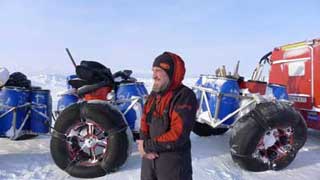
| Russian Exploresr of the Arctic: Sergei Isaev and Vladimir Obihod inside Yemelya-4 amphibios vehicle. |
April 17-19 2011 Russian Arctic Expedition
 |
| Arctic Sun MLAE-2011 Russian Arctic Expedition |
 |
| Vladimir Obihod Arctic Explorer |
 |
| Polar Bear tracks in the Arctic |
 |
| Russian Arctic Expedition MLAE-2011, Arctic Explorers Vasiliy Elagin, Vladimir Obihod, Afanasiy Makovnev, Sergey Isaev, Andrei Van'kov, Aleksei Zaicev, North pole expedition, Driving to the North Pole |
 |
| Arctic Polynyas, Thin Ice Yemelya Vehicles in water Russian Arctic Expedition |
 |
| Kara Sea Arctic Ridges MLAE-2011, Russian Arctic Exploration, Russian Arcitic Expedition |
Saturday, April 16, 2011
April 16th 2011


Getting through to Severnaya Zemlya has been quite something else. Not since the Pobeda Peak have I had to work this hard. The “warm” Kara Sea apparently had no intent of letting us leave it. Though it is starting to seem as though we are finally parting. I will never forget this pond, though. The view outside is beyond what Roerich could have dreamed up. A pastel-like sunrise, day-night. Outside is bright, ridges, icebergs, shore. We think to reach Golomyanniy Island by tomorrow night. The shore ice belt is solid. Although, every time we begin to dream is exactly when s@#%* happens. We shall try, though. Wind is moderate, inside the vehicles it is warm and in our sleeping bags – even warmer. Overall everything is great.

Sergey Isaev
Translated from Russian by Ilya Kovalev

Translated from Russian by Ilya Kovalev
Friday, April 8, 2011
April 8 2011
Apr 8
 I’ll keep it short today due to tiredness. The ice floe itself has drifter off, leaving us on the shore ice belt by 0430 hours on Sivash. A large bearded seal watched us as if wondering: “what are they doing wondering around here?” And we would be happy to leave ourselves, yet the Kara Sea has got a hold of us and does not let go. While our avant-garde went to off to check the ice situation around, we did a complete inventory of everything: ropes, diesel, manhood and humor. From the looks of it we are still doing alright.
Vasily Elagin.
Translated from Russian by Ilya Kovalev
Translated from Russian by Ilya Kovalev
Thursday, April 7, 2011
April 7 2011
 We are presently near Voronin Island. A tall lighthouse is visible from here, but we are separated from it by a large polynya ranging from 300 to 3000 meters in width. To cross over to the shore ice belt we need to find the place where the polynya is most narrow. Wind is out of North East and strengthening. Driving north along the polynya we find a narrowing of no more than 200 meters in width covered with thin ice. Men come out on the ice with the picks, and report back that they think the vehicles without trailers will be able to make a dash and reach the water without falling though the ice.
Factoring in the wind we pick the spot on the other side where to get out of the water. The decision to cross afloat is made.

We prepare the boat, the blocks, the dollies and Kevlar hawsers; we designate responsibilities and roles between members of the crew; everyone will be involved. By now the thin ice cover begins to tighten around the open water until it vanishes right before our eyes. The water still, however, remains open to the right and to the left. Our only chance at crossing now is to drive fast over the thin ice and dive into the still uncovered water.
Ice fields close over the water completely and begin to crawl onto one another and soon become drivable The vehicles are speeding over 12 sm ice. It is sags, but holds! Now trailers. We have six of them. The “dispatcher” gives the go ahead to the first “train” consisting of three trailers. Kevlar cables are tied to the hitch of “Yemelya-4”, guide dollies with blocks are stuck into the ice and the “train” is underway. Going over a stretch of thin ice the trailers fall through it and are now floating on their tires. Our team gets to pulling the cables by hand to help “Yemelya” and eventually the trailers with our food, fuel and personal belongings roll out of the water and onto the ice. All things are safe, secure and dry in the water tight plastic barrels. Second train overcomes shorter distances from one ice field to another. We gather all the metal gear.
Translated from Russian by Ilya Kovalev
Translated from Russian by Ilya Kovalev
Sunday, January 2, 2011
About The Arctic Expedition MLAE-2011
MLAE-2011 expedition has been organized by the
Russian Center For Arctic Exploration and is carried out under the patronage of the Special Representative of the President of Russian Federation In International Cooperation In The Arctic and the first vice-president of the Russian Geographic Society A.N. Chilingradov. The expedition is currently traversing the ice of the Arctic Ocean under the flag of Russian Geographic Society. Upon reaching the North Pole, the expedition will head south to Canada and is expected to wrap up in Resolute (Qasuittuq), in the Canadian territory of Nunavut, around June 15, 2011
The expeditionary crew is traveling in two custom built amphibious vehicles “Yemelya-1” and “Yemelya-2” following the route:
Urengoy – Dudinka – Dickson – Ostrov Sredniy – ice base Borneo - The North Pole – Ward Hunt, Canada – Resolute (Qasuittuq), Nunavut.
The crew list of Marine Live-ice Automobile Expedition 2011 (Short Biographies here)
Expedition successfully traversed 2033 kilometers of the Arctic waters and ice between Ostrov Sredniy island of Severnaya Zemlya archipelago and The North Pole. The route took 38 days between 20th of March and the 26th of April 2009. The expedition was carried out under the patronage of Russian President’s Special Representative for The International Cooperation in The Arctic and The Antarctic A.N. Chilingradov. The support and safety monitoring of the expedition and the crew was provided by the aviation department of Federal Security Bureau. Expedition was headed by the decorated Master of Sport V.I. Yelagin. Expeditionary crew consisted of seven people. Vehicles used to traverse the ice and water en-route were two custom designed and built vehicles “Yemelya-1” and “Yemelya-2” with three axels and 6x6 wheel drive equipped with diesel engines, low pressure tires and cargo trailers.
Translated from Russian by Ilya Kovalev
 |
| Expedition Flag |
 |
| MLAE-2011 Expedition Shevron From Russian Arctic to Canadian Arctic |
EXPEDITION OBJECTIVES ARE:
Reaching the North Pole
Field testing amphibious
"Yemelya" vehicles.
It is, also, our hope that the expedition will help to instigate and maintain the dialogue and cooperation in research and development of the Arctic between the two Nations over the territories of which its course lay.
MLAE-2011 expedition has been organized by the
Russian Center For Arctic Exploration and is carried out under the patronage of the Special Representative of the President of Russian Federation In International Cooperation In The Arctic and the first vice-president of the Russian Geographic Society A.N. Chilingradov. The expedition is currently traversing the ice of the Arctic Ocean under the flag of Russian Geographic Society. Upon reaching the North Pole, the expedition will head south to Canada and is expected to wrap up in Resolute (Qasuittuq), in the Canadian territory of Nunavut, around June 15, 2011
The expeditionary crew is traveling in two custom built amphibious vehicles “Yemelya-1” and “Yemelya-2” following the route:

 |
| MLAE-2011 Route Map |
 |
| Vasiliy Elagin Expedition Chief |
№ Name Title
1. Vasily Elagin…………………………expeditionary chief
2. Afanassi Makovnev………………….2nd in command
3. Vladimir Obihod…….........................driver-engineer
4. Andrey Vankov……..........................driver-engineer
5. Alexey Zaitsev…………………….....driver-engineer
6. Vladimir Yanochkin…..........................driver-engineer
7. Sergey Isaev……….............................driver-engineer
In 2009 Marine Live-ice Automobile
Expedition successfully traversed 2033 kilometers of the Arctic waters and ice between Ostrov Sredniy island of Severnaya Zemlya archipelago and The North Pole. The route took 38 days between 20th of March and the 26th of April 2009. The expedition was carried out under the patronage of Russian President’s Special Representative for The International Cooperation in The Arctic and The Antarctic A.N. Chilingradov. The support and safety monitoring of the expedition and the crew was provided by the aviation department of Federal Security Bureau. Expedition was headed by the decorated Master of Sport V.I. Yelagin. Expeditionary crew consisted of seven people. Vehicles used to traverse the ice and water en-route were two custom designed and built vehicles “Yemelya-1” and “Yemelya-2” with three axels and 6x6 wheel drive equipped with diesel engines, low pressure tires and cargo trailers.
Translated from Russian by Ilya Kovalev
Thursday, April 23, 2009
MLAE-2009 Vasily Elagin Arctic Expedition to The North Pole in Yemelya Vehicles
MARINE LIVE-ICE AUTOMOBILE EXPEDITION TO THE NORTH POLE 2009
MLAE-2009
Traveling in an automobile over the ice is challenging enough even when the surface is merely ice covered asphalt. When the road lay across ice floes floating over miles of ocean waters with unpredictable currents underneath that cause these large ice fields to shift and collide creating meters high ridges, then car travel becomes a thing in itself, a challenge for both - resilience and resourcefulness of men and dependability and versatility of the machines.
Amidst the white endlessness of the Arctic Ocean there is an infinitesimally small point – the North Pole. Explorers, scientists and adventurers have been traversing the ice of the Arctic to reached this invisible point on foot, in dog sleds, on skis, in airplanes and gigantic atomic engine powered ice breaker ships. Never before, however, had anyone traveled all the way to the North Pole in an automobile.
Not until on April 26th 2009 the Russian crew of seven men had accomplished the feat by reaching the North Pole in two auto vehicles “Yemelya”, thus contributing to Russia’s leadership in Arctic exploration and research and establishing the new world record in Northern travel and exploration using wheeled vehicles.
The following three objectives of the expedition had been established and successfully met:
1. Establishing Russia’s leadership in Arctic research and exploration by expanding research and development capabilities through the introduction and field testing of the surface vehicles capable of handling Arctic ocean ice and waters while establishing the new world record in Northern exploration and travel using wheeled vehicles.
2. Field testing and proving effective the new innovative design of engineer Elagin’s “Yemelya” amphibious all terrain vehicles.
Over the course of the expedition the unique and innovative design of “Yemelya” vehicles proved to be efficient and resilient, perfectly fit to tackle unpredictable ever changing conditions of the frozen surface of the Arctic Ocean. Until now civil and military aviation had been the primary if not only mode of transportation for staff and equipment in the Arctic research. Capabilities of aviation in this capacity is greatly limited by two factors: the weather conditions and the high costs. The other alternative to aviation is of course vessels, however, the waters of the Arctic can only be navigated about three months per year, which limits the capability of marine transportation in the region to an even greater extent. “Yemelya” vehicles are the new, capable and effective alternative to traditionally primary Arctic research vehicle – helicopter. Unlike the helicopter, however, “Yemelya|” can be deployed in any weather conditions and as such is valuable and essential vehicle that can assure uninterrupted, reliable transportation, communication and supply between remote communities of the far North as well as the remote bases and outposts in the Arctic.
“Yemelya” can become essential vehicle for the scientific expeditions exploring the Arctic seabed, it can be an invaluable transportation for the northern communities as well as an irreplaceable instrument in the work of the search and rescue services in the North.
Yet another unique aspect of the “Yemelya” vehicles, according to their designer, creator and the expedition leader – Vasily Elagin – is that, unlike caterpillar equipped off-road vehicles, Yemelya’s large, low pressure tires tread so lightly even on the most ecologically sensitive and vulnerable terrain of tundra that they leave virtually no marks.
This expedition successfully reinforced Russia’s leadership in Arctic exploration and proved “Yemelya” to be the perfect off road vehicle for transportation over tundra terrains as well as both – frozen landmass, as well as live shifting ice floes of the Arctic Ocean.
Subscribe to:
Posts (Atom)